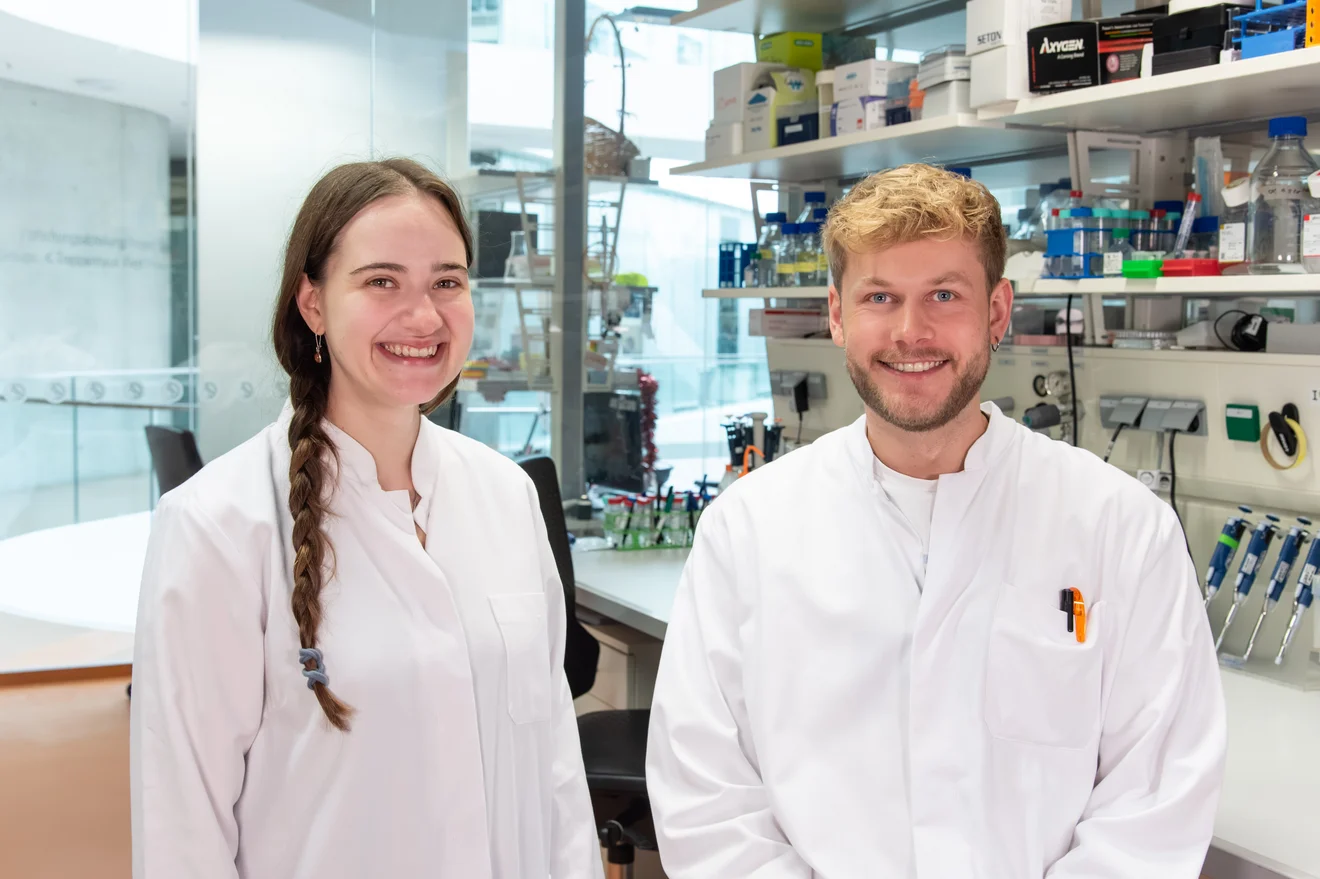
Chrysa Kapsali & Remo Bode: Two Perspectives, One Bigger Picture
How two PhD projects grew into a collaboration
Remo Bode, from the CGA class of 2024, studies ADP-ribosylation of proteins in the Matic Lab, while Chrysa Kapsali, from the class of 2023, investigates ADP-ribosylation of RNA in the Huppertz Lab. Although their PhD projects focus on different molecules, they share a biological system - and a growing interest in the bigger picture. We talked to them about how a scientific connection developed into a collaboration, a friendship, and an unexpected new chapter in Remo's PhD journey.
Every collaboration has a beginning, but many never get beyond a good conversation. What made yours actually happen? Looking back, what was the key step that turned an idea into a real project?
Remo: For me it was quite straightforward: I interviewed with Ivan during the CGA recruitment week and told him about my interests in stemness and chromatin regulation. This brought him to mention Ina’s lab and Chrysa’s project as a possible connection point. I was accepted to the CGA, started working on the project, and the rest is history. It’s probably more interesting from Chrysa’s point of view.
Chrysa: As Remo said, the idea of the potential interconnection came up even before Remo joined the institute. It is very conducive that both of our PIs are very open to collaborations and value sharing ideas, expertise and materials. But ultimately, the collaboration also depended on how well we communicated with each other. Remo and I have very similar attitudes towards collaboration, and over the years we developed a very good connection and became friends through activities both inside and outside the campus. As a result, we feel very comfortable to contact each other, even with “dumb” questions or incomplete ideas.
A PhD often feels like your project. Was it difficult to share part of it? How did you decide what to tackle together and what to keep independent?
Chrysa: It wasn’t difficult, because from the beginning we both were very open and shared everything. We each have a different molecule as our central focus (RNA and protein) and that is quite easy to separate, so our research can be complementary, but doesn’t fully overlap. What we tackle together tends to be the interpretation and framing of our results; finding the connection points between the data we each generate is genuinely one of the most exciting parts of the collaboration.
What stays mostly independent is the generation of data and the methods behind it, since RNA- and protein-focused approaches require different strategies. However, the instances in which data generation overlaps are a happy occasion for both of us. For example, Remo is developing some cell lines that could potentially be used by both of us. And there have been instances that I checked the protein as a control and discovered some responses that might be interesting to Remo’s approach. Sometimes we share samples in which each can test individual responses, with different techniques. This saves time and money for everyone.
Looking back, is there one moment that perfectly captures what it’s been like to collaborate, whether it was a breakthrough, a setback, or simply a conversation that changed the way you thought about your project?
Remo: If I have to pick one moment, it’s not a scientific breakthrough - it’s more personal. My PI recently announced he’s moving to a different city, and I was faced with a decision: leave Cologne, or start a new project mid-PhD. I didn’t want to leave and because I was already so closely embedded with Chrysa through this collaboration, switching labs felt like a straightforward answer to my problem. We’re now going from being collaborators to actual lab colleagues - and have been friends for a while. That’s the moment that really crystallized it for me: a collaboration can benefit your science, but it can also end up shaping the whole path of your PhD. And I am certain there will be a scientific moment marking our collaboration in the future, too.
What has surprised you most about working together? Has the collaboration changed the way you think about your own research—or even about doing science?
Chrysa: Collaborating with people that have completely different expertise and are approaching a question from a different point of view is invaluable. Sometimes we get so immersed in our project, that we really limit our perspective of biology to a specific response or a specific mechanism and we end up ignoring the bigger picture. Doing science openly, sharing and collaborating helps alleviate this lack of perspective. We both think that science should be done that way and our experience has only corroborated that. Through a collaboration, we constantly change the way that we think about our own research and we add to each other’s perspective and that’s the whole point.
Imagine another CGA student has an idea for collaborating but isn’t sure whether it’s worth the effort or doesn’t know how to get started. What would you tell them?
Remo: I’d start by emphasizing how important it is to talk to people - get to know colleagues from your institute, but also the wider campus and beyond. Every person you’ve talked to is no longer a stranger, and therefore approachable, whether you need a reagent, some knowledge transfer, or, best case, a collaborator. So, go to events, engage with people, and show honest interest - you and they will both benefit.
Building up on that, the stronger your network, the easier it becomes to turn a collaborative idea into something real. My advice on ‘is it worth it’? If you find a project that shares your model system or a related biological question, it’s almost always worth at least one conversation to explore it, even if it doesn’t go anywhere. And how could you get started? Don’t overthink the first step. Go to someone’s presentation, learn what they are doing, have an informal chat with the other student first, and see where this leads you. Then bring your ideas to your PIs. Getting your PI’s support early is important - in Chrysa’s and my case, it helped a lot that our PIs were also open and interested in each other’s works.